
Clark County Directory Collections
Clark County historical directory research is spread across institutional catalogs, microforms, special collections, and licensed library resources. The runs are not one continuous set, and several catalog leads still need edition-level confirmation. That distinction matters: a finding aid can establish that a collection exists, but it does not promise a scan, a current checkout path, or a complete sequence of years. Begin by recording the published title and year, then ask the holding institution about the specific reel, volume, or access rule.
| Collection | Years | Where Held | Access |
|---|---|---|---|
| Nevada Territory directories | 1861-1882 | UNLV Microforms | Four-reel collection record |
| Las Vegas telephone directories | 1931, 1934, 1946 | Library and genealogy catalog leads | Confirm the item and holding |
| Regional telephone directory | 1937-1938 | Library and genealogy catalog leads | Las Vegas, Boulder City, Overton, and Moapa Valley coverage |
| Directory of Las Vegas and Clark County | 1954-1955 | Henderson Libraries catalog description | Confirm edition and availability |
| Leavitt address and parcel indexes | 1968-1981, bulk 1973-1981 | UNLV Special Collections | Collection-level archival access |
| Las Vegas Valley street directory and maps | 1975; 1975-1981 | UNLV Regional History Files and maps/guides | Historical address context |
The identified gaps are useful information. No direct official item URL was located for several telephone-directory leads, and the research did not establish a single uninterrupted publishing run. A missing listing can reflect a gap in the collection, a name variation, or an edition that did not cover the address.
Note: Record the publication year and collection citation before treating any absence as evidence about a person or address.
Clark County Historic Directory Years
The UNLV Microforms description identifies Nevada Territory directories for 1861 through 1882 on four reels. Its description says the volumes can include residents, residences, heads of family, firms, institutions, advertising, and street-directory sections. They are a statewide and territorial source, so a Clark County search must be tied to the locality and date printed in the volume.
Later leads become more Las Vegas Valley focused. The 1954-1955 county-wide title, entries for 1954, 1957, and 1959 in U.S. City Directories collection leads, and the 1975 Las Vegas Valley street directory each need their exact edition checked before use. A dated volume can provide a bridge between census decades, but it does not show the full population or confirm a later move.
Clark County Library Collection Paths
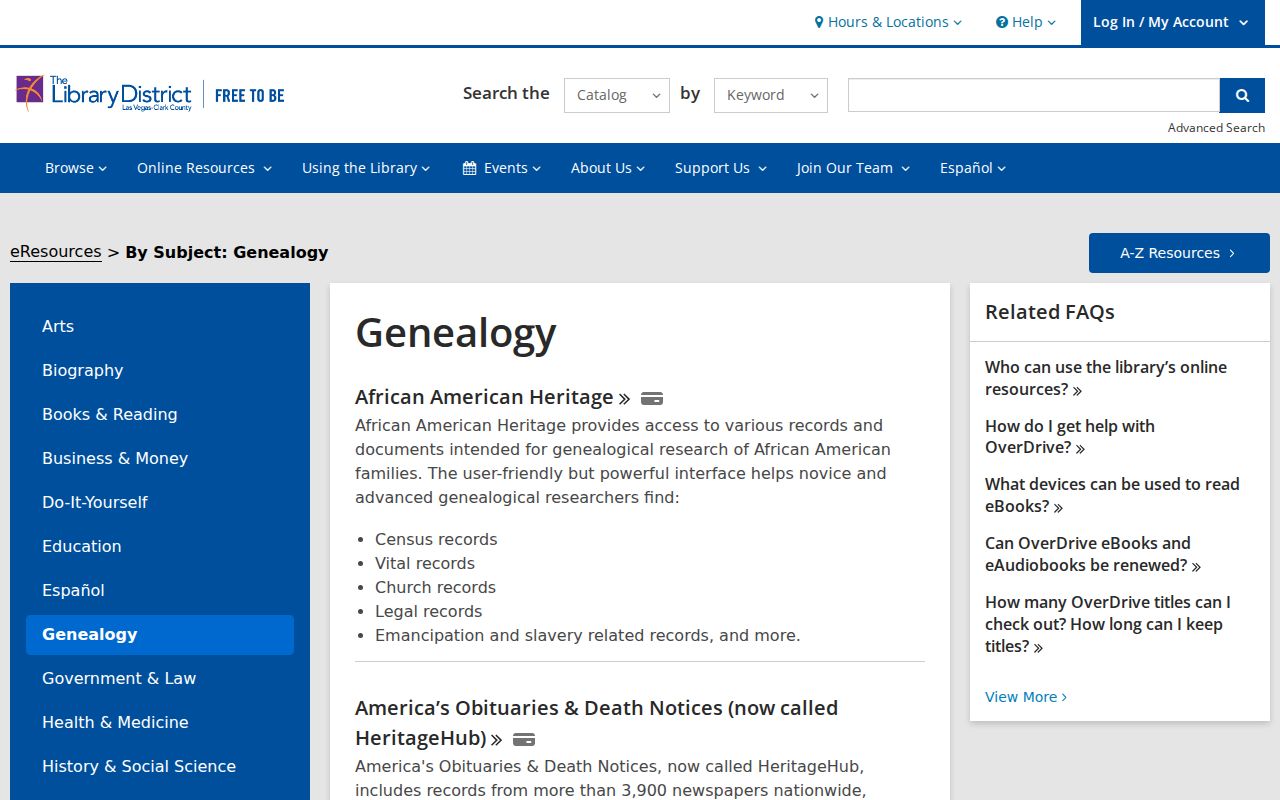
Las Vegas-Clark County Library District genealogy resources are the main local online starting point. They describe library-card resources such as HeritageHub, HeritageQuest, newspaper collections, historical Review-Journal facsimiles, and local collections. Access can differ by provider or branch, so the current library information should be checked before planning a remote or in-library search. HeritageHub is described as including obituary and death-notice material from about 3,900 newspapers and roughly 63 million listings.
A view of the Library District genealogy resources shows the research services that can supplement a Clark County historical-collection trail.
Use those services to locate a newspaper notice, census entry, or local-history source that independently dates the address found in a volume.
UNLV adds a different route. Its Regional History Files include the 1975 street directory, Review-Journal files, and community material, while related collection descriptions cover Las Vegas maps and directories from 1975 through 1981. These are complementary sources, not substitutes for the original directory edition.
Clark County Collection Custody Routes
Historical research crosses more than one government boundary. Clark County contains Las Vegas, Henderson, North Las Vegas, Boulder City, and Mesquite, as well as unincorporated and rural communities. A Las Vegas postal address does not by itself establish that the City of Las Vegas held the original municipal record. Use the parcel, assessor situs, and city-boundary layer before routing a permit, city-court, licensing, or clerk request.
For civic context, UNLV City Commission records preserve Las Vegas minutes, ordinances, indexes, and cemetery-board material from 1911 through 1960. Those records can explain a street opening, neighborhood change, or municipal decision near a historical address. They do not establish who lived there. County map layers offer city, unincorporated-town, street, district, and TAB/CAC routes for checking jurisdiction.
Note: Route a request to the actual custodian, because county public-records staff do not hold every record created within Clark County.
Reading a Clark County Directory Entry
A historical entry should be transcribed as a bundle of dated details, not reduced to a name alone. The entry may use initials, an old street form, a business or firm reference, a telephone number, or a cross-reference. A name match still needs corroboration. Compare it to a map, newspaper, census record, recorder document, or another dated source before joining it to a particular person.
| Edition and page | Publication title, year, page, reel, or item identifier. |
|---|---|
| Name form | Surname, given name, initials, suffix, and any cross-reference printed. |
| Street form | Number, street spelling, direction, unit detail, and historical form exactly as printed. |
| Listing context | Household, firm, institution, business, or telephone information if the edition prints it. |
| Corroboration | Map, newspaper, recorder, census, or archival source used to test the connection. |
- Criss-cross directory
- A reverse section arranged by street address rather than by surname, useful for checking the printed sequence along a street.
- Householder index
- An index centered on a household name or address reference. Its scope follows the publisher's choices, not a complete count of residents.
- Abbreviation key
- The publisher's decoding list, often near the front of a volume. Photograph or note it before interpreting shorthand.
Clark County Directory History Markers
Clark County was created in 1909, Las Vegas was incorporated in 1911, and the courthouse was completed in 1914, according to the official county timeline. The 1905 townsite grid, later subdivisions, maps, and directory runs explain why a historical street name may require a cross-era check rather than a simple modern-address search.
- 1905: The Las Vegas townsite auction established the original grid described by the city timeline.
- 1909: Clark County formed from Lincoln County.
- 1911: Las Vegas incorporated, and City Commission records begin their documented 1911-1960 run.
- 1946: UNLV's cadastral map supplies indexed city-map context for a mid-century address check.
- 1968-1981: The Leavitt collection carries homeowner, address, map, ownership, and parcel-number indexes.
Local timeline and historic-survey material are useful place-history companions. A historic building or address can retain documentary importance even after the structure changes, so identify the source date and avoid treating historic context as a statement about a current resident.
Trace Clark County Historical Directories
To trace a household, start with a year near a known event and move one edition at a time. Keep name variants separate until the address, relationship, map evidence, or another dated record supports a connection. This sequence is especially helpful when a family appears between federal census years or when a street form changed in print.
- Find the first located listing and save its edition, page, and the exact name and address form.
- Check the next available edition, then work backward and forward for moves, spelling changes, or cross-references.
- Use the reverse or street-address material, when the collection provides it, to test the printed address sequence.
- Pair the dated volume with the closest census year, newspaper notice, map, or archival record.
- Use recorded documents or probate material only when a property or family connection needs lawful documentary corroboration.
A disappearance from a volume is not conclusive. The person may have moved, been omitted, used a variant, appeared only under a firm or another household member, or fallen within a collection gap. For modern address-keyed research after the historical trail is established, use the Clark County street directory route rather than assuming the old listing remains current.
Note: Preserve the source date with every address, because a historical listing cannot confirm present-day residence or legal title.
Clark County Directory Access Limits
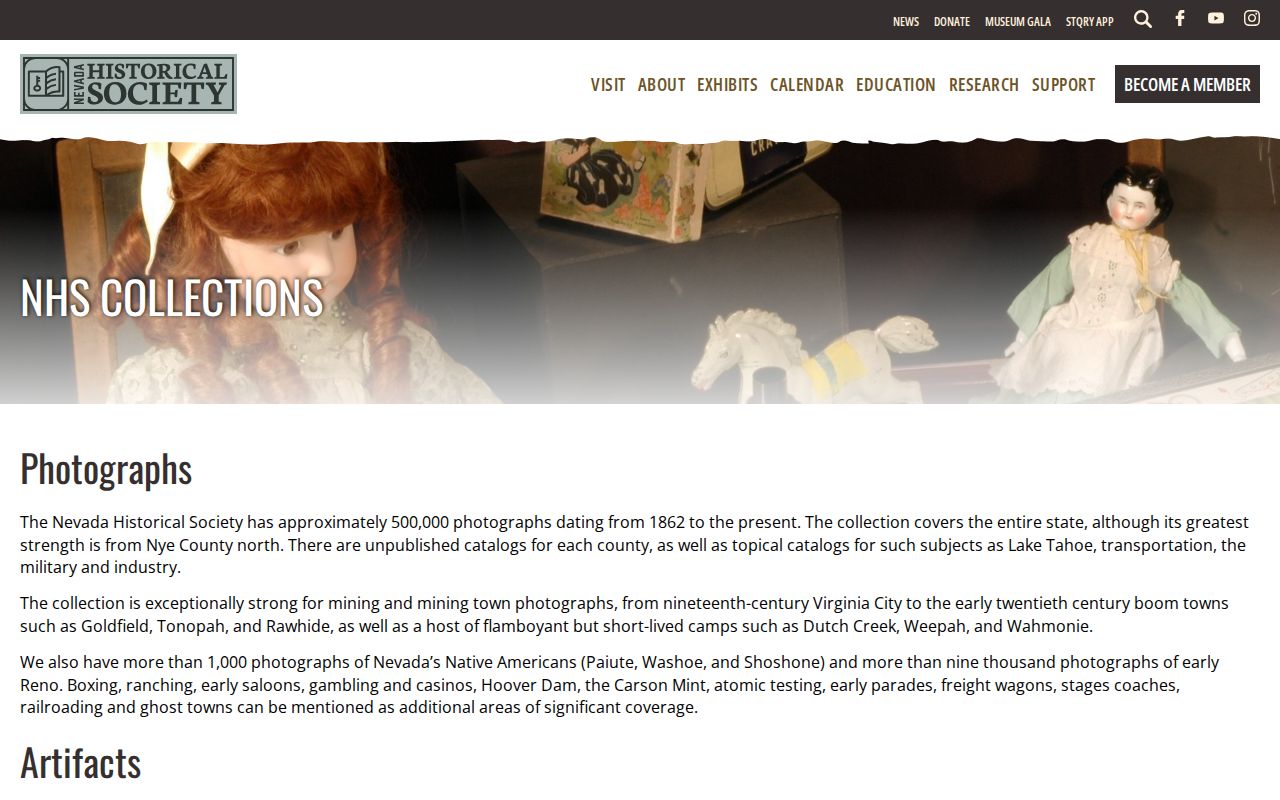
The Nevada Historical Society has books, newspapers, manuscripts, maps, state documents, ephemera, and about 500,000 photographs in its described collections. Its collections page is the source for the historical-material categories shown here. Its research library notice says the library is closed for renovations from January 2025 through December 2026, with limited access. Use its current request route before planning a visit. The Clark County Museum is another collection contact for archives, historic buildings, and Heritage Street material.
The museum lists 1830 S Boulder Highway in Henderson, 702-455-7955, daily hours of 9:00 a.m. to 4:30 p.m., and free admission. Its archives and Heritage Street homes, dated from the 1910s through the 1970s, make it a practical fallback when a digitized directory, newspaper, or map result is incomplete.
An image from the Nevada Historical Society collections represents another archival route for Clark County historical-directory research.
Contact the institution about the specific book, newspaper, map, manuscript, or photograph before relying on its availability or reproduction status.
A finding aid, catalog result, or directory image is not a complete records archive. Dynamic services can change, licensed resources can require a library card, and holdings can have format or rights limits. Nevada's NRS Chapter 239 gives a general public-records access rule, but historical collections and restricted records still follow the custodian's access terms.