
Clark County Previous Residents by Era
A backward address trail is strongest when its records overlap. Start with the current assessor parcel, then obtain the recorded-instrument identifiers that connect one owner or legal description to the prior one. For a household clue, use a directory, map, newspaper, or census source that is dated near the period being tested. Clark County has no single source that covers every address and every era, so the appropriate starting point changes with the property and the years involved.
| Clark County source | Era and access | Where to look | What it contributes |
|---|---|---|---|
| Assessor parcel and title paths | Current search route; sales data files described as approximately 1994 forward | Clark County Assessor | APN, situs, legal description, current vesting, map, sales and title-history leads |
| Recorder official-records index | Public online start is not stated by the Recorder | Recorder index, copy order, mail, or counter | Recorded party roles, document type, date, APN, instrument, and legal-description clues |
| Leavitt address and ownership indexes | 1968-1981, with bulk material from 1973-1981 | UNLV Special Collections | Address sequence, homeowner, parcel-number, map, and ownership clues |
| Street directories and maps | Las Vegas Valley street directory in 1975; maps and guides from 1975-1981 | UNLV Regional History Files and maps collection | Dated street form, map context, and a household or neighborhood lead |
| Newspapers and local-history sources | Collection-specific runs, including Las Vegas Age 1905-1947 | UNLV and Library District resources | Dated address, event, obituary, or community context to corroborate another source |
For a modern parcel, the property route usually comes first. For an early Las Vegas address, begin with the legal description, maps, directories, and dated newspapers, then test the connection against a recorded document. A blank online result can mean a coverage gap, altered address form, different custodian, or record not indexed under the name used.
Clark County Parcel Starts the Trail
The Clark County Assessor's Real Property Records route supports searches by parcel number, owner, address, subdivision, subdivision owners, parcel type or book-page, parcel tree, and map inquiry. Save the APN, situs address, owner or vesting field, legal description, lot or block, map link, and access date. The situs is the parcel-location field; the mailing address is a tax-contact field and can differ.
Use AssessorMap to view parcel, lotline, and easement context. Parcel maps are assessment aids, not surveys. If the property was split or merged, the current APN may differ from the historic number. In that situation, a subdivision reference, lot and block, recorded map, or legal description is usually a better continuity key than the modern street address alone.
Note: Record the current address exactly as matched, but do not assume a tax-mailing address identifies who lived at the parcel.
Clark County Deed Chain Backward
The Recorder's index is the core title trail for past owners. It can search name, parcel number, instrument number, document type, book or page, record date, total value, and legal description. A name search requires a last name or company, with an optional first name and starts, contains, or exact matching. Use the parcel facts to find the current purchase or transfer, then use the parties and legal description to locate the prior transfer.
- Get the current APN, vesting or owner lead, and legal description from the Assessor.
- Search the Clark County Recorder official-records index by APN, instrument, and party name. Confirm the document type and recording date.
- Identify the seller or prior interest holder in the confirmed instrument, then search that name as a grantee for the earlier acquisition.
- Repeat the process while comparing APN, lot or block, subdivision, and legal-description wording. Do not rely on a surname alone.
- Order the document image when the index shorthand cannot establish the party role or legal detail. Copies are available online, by mail, or in person.
- Grantor
- The party shown as transferring or conveying an interest in a recorded instrument.
- Grantee
- The party shown as receiving an interest in the recorded instrument.
- Chain of title
- The sequence of recorded transfers and related instruments used to trace an interest through time.
- Legal description
- The lot, block, subdivision, or other land description in the instrument. It can remain useful when the street form changes.
Recorder index summaries are leads, and original records are not generally posted as public website images. The Recorder lists online copies at $1 per page plus $4 certification, a 2 percent total fee, and a $1.25 online charge. Email PDFs generally take 1-2 business days, while domestic paper delivery generally takes 7-10 business days. Pre-1988 page counts may require an email request.
Clark County Recorder Future Watch
The Recorder's free Recording Notification Service is useful after a parcel or name variant has been identified. It accepts a name and or APN after email confirmation and sends alerts for documents recorded after signup. It does not supply a historical chain, and same-name alerts need to be checked against the parcel and instrument before they are used as a history lead.
The Clark County Recording Notification Service portal shows the name and APN alert signup route.
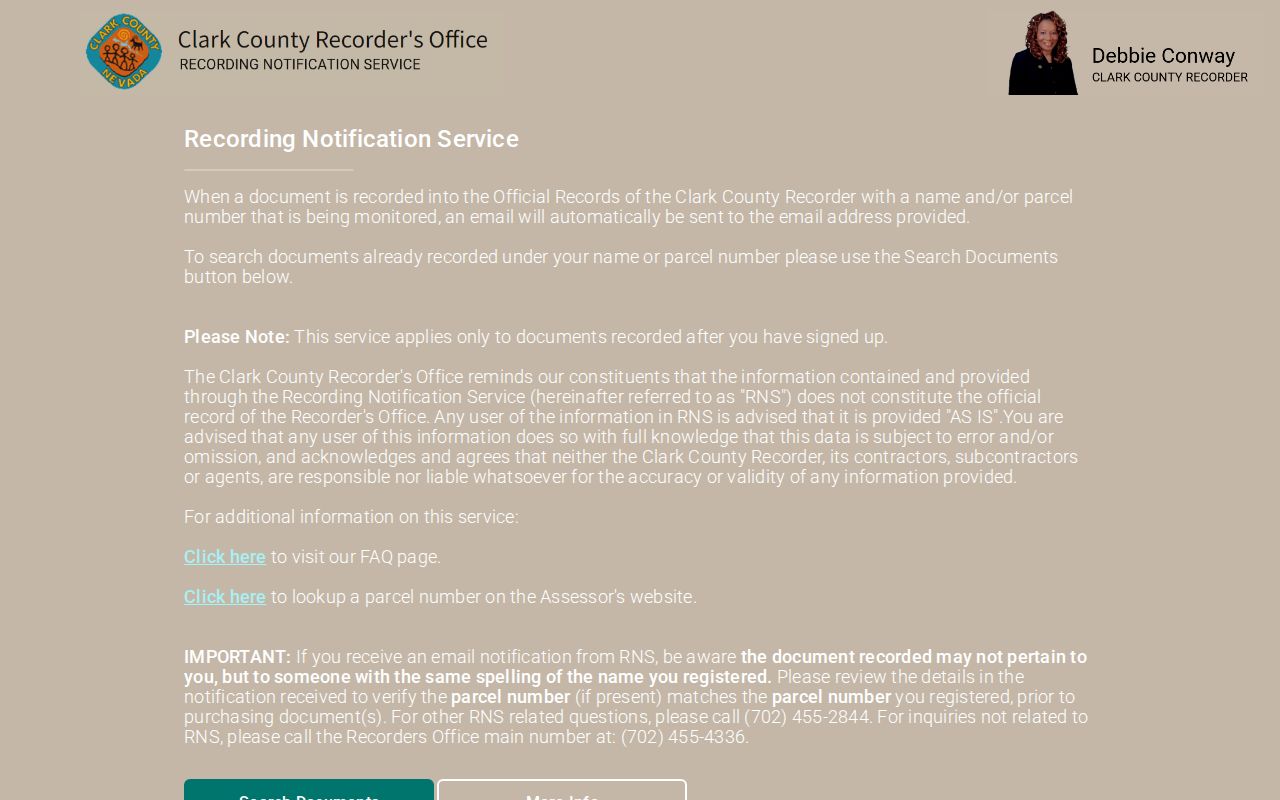
The alert is a monitoring tool, not an official record or historical backfill. Keep the alert date separate from the recorded document date, and verify any notice through the Recorder index before ordering a copy.
Clark County Leavitt Address Indexes
For mid-century address work, the UNLV Jack K. Leavitt Collection is the strongest reverse-directory-like local source located. Its 31 indexes include alphabetical homeowner and address material, Las Vegas and Henderson maps, ownership indexes, street-address sequence, and parcel-number ownership indexes. The collection spans 1968-1981, with most material from 1973-1981.
Those indexes can connect an older address form with a homeowner, a map, or a parcel clue. They do not settle title or prove a resident's present location. Pair a Leavitt hit with a dated Recorder instrument, permit, directory, newspaper, or census source. The underlying collection details and related historical directory runs are available through the Clark County city directory collection guide.
Clark County Maps for Past Addresses
Maps can show why a prior address does not fit a current street search. UNLV's digitized 1946 Las Vegas cadastral map includes indexes and offers a visual continuity check for an older city address. It is a historical map, not a current boundary record. Compare it with the current parcel and recorded map rather than treating its labels as present-day facts.
The UNLV 1946 cadastral-map record documents its June 1, 1946 map, indexes, and digitized TIFF.
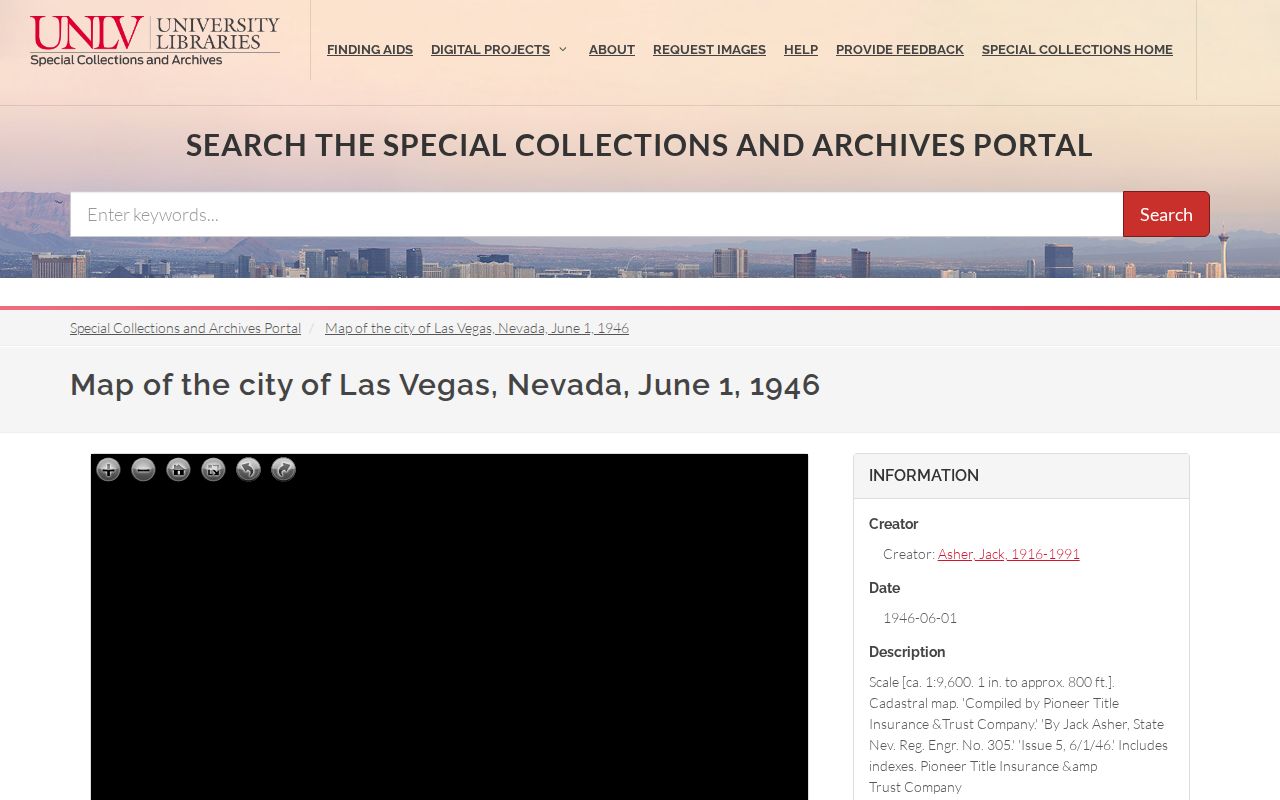
The Library of Congress also catalogs a January 1928 Las Vegas Sanborn item with 15 sheets, but that item is not available online because of rights restrictions. Search the catalog and local holdings rather than assuming every historical sheet can be viewed or downloaded.
Clark County Permit and Archive Trail
A building record can add a date and project description to an address history. Clark County's document image search accepts record number, parcel, location, and document type. Citizen Access searches address, parcel, owner, record information, permit, project, and related fields. Search both systems because Citizen Access defaults to the last five years while legacy material may hold older records.
For an older event, use UNLV newspaper holdings, the Library District genealogy resources, or a local-history collection to locate a dated article or notice. The Las Vegas Age holdings are listed for 1905-1947, while Review-Journal material has different listed institutional runs. A newspaper hit needs its date, page or item citation, and independent corroboration before it is tied to a household.
Note: Missing digital plans and copyright-restricted plans are documented county limitations, not proof that no project record exists.
Clark County Past Household Evidence
Past owners and past residents are not always the same people. Dated directories can show an address, name, occupation, household designation, telephone number, or cross-reference when printed. Federal census material, newspapers, obituaries, and local collections can add a household context. Each source needs its publication or event date, because a resident listing may be accurate for one edition and stale for another.
Pair a directory year with a census period, then test the same name and address through a Recorder instrument, permit, map, or newspaper. UNLV Microforms describes Nevada Territory directories from 1861-1882 on four reels, while later Las Vegas directory leads include 1931, 1934, 1937-1938, 1946, 1954-1955, 1957, and 1959. Several of those later leads do not have a direct official item URL, so verify holding and access before treating any one as digitized full text.
Obituaries and death notices can supply a date, relative, or place-history lead. They do not independently prove every listed address. For a deceased person, corroborate the event through the proper vital, probate, Recorder, or archival source where access is allowed.
Clark County Previous Residents Need Proof
Use a sequence, not a single match: directory address plus newspaper clue plus deed, permit, or census household. Check initials, middle names, suffixes, married names, business names, neighborhood labels, and older street forms. The Recorder's party role, the Assessor's property role, and a directory's household clue are different types of evidence. Keep them distinct instead of relabeling each one as a resident.
Clark County began in 1909, Las Vegas incorporated in 1911, and the courthouse was completed in 1914. Early records are distributed across Recorder, Clerk, court, city commission, newspaper, directory, map, and archive collections. That dispersed history is why a legal description and a dated map often help more than a modern address-only query.
Note: No official countywide street-renumbering table was located, so confirm a changed address with at least two dated sources.
Clark County Historical Privacy Lines
Nevada public-record access does not make every field available for publication. Voter files can omit confidential fields, protected Recorder information may be withheld, and vital records have statutory access rules. NRS Chapter 239 generally opens nonconfidential public records during office hours, but the relevant custodian controls the record and any redaction decision.
Lawful use. Research past residents for family history, estate questions, house history, or personal curiosity. Do not use a historical record to stalk, harass, intimidate, or expose protected information about a living person.